
odio CI/CD: build, test, and release pipeline
You don’t need to know the whole CI/CD pipeline to contribute to odio. The sections below cover it piece by piece, with the workflow files linked inline, so you can jump straight to the part you care about. The pipeline runs on GitHub Actions; from a v* tag on a component repo to a signed .deb on apt.odio.love, it’s short enough to trace end to end whenever you do want the full view.
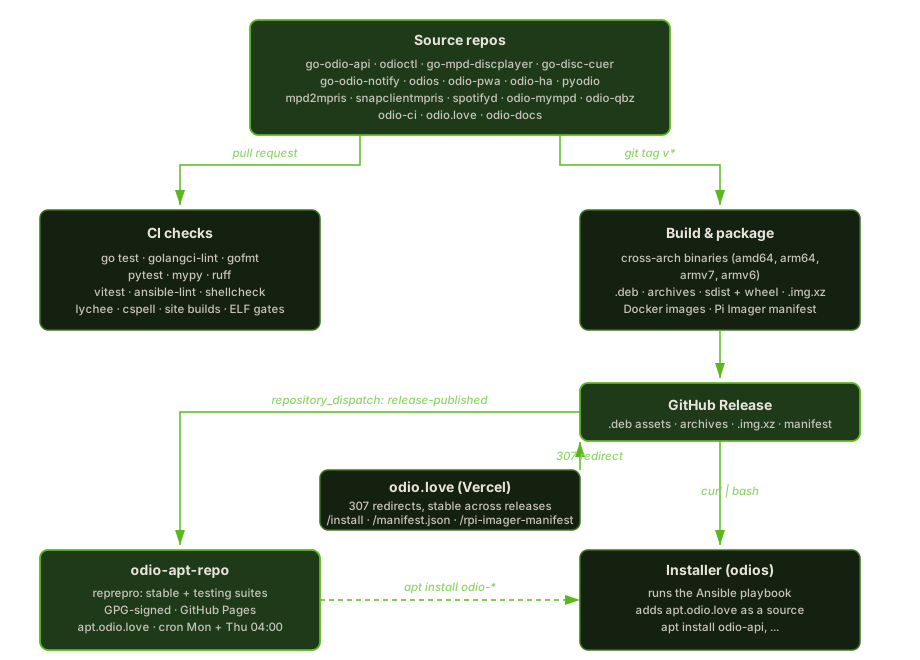
CI on every pull request
Section titled “CI on every pull request”Nothing merges to main without the relevant checks running green. The details vary by language:
- Go repos (go-odio-api, go-odio-notify) run
go test -race, a coverage gate (15% minimum, uploaded to Codecov), golangci-lint v2.5.0,gofmt, and ago mod tidydrift check.go-odio-apipins Go 1.25 and compiles the embedded Tailwind CSS via Task before the test and lint steps, because the binary ships the UI as an embedded asset;go-odio-notifyruns the same checks across Go 1.24 and 1.25. go-mpd-discplayer checksgofmtand runs golangci-lint on Go 1.25, with the cgo headers it links against (ALSA, libdiscid, libudev) installed first. - odio-pwa runs
svelte-checkand the Vitest suite on Node 26. - odio-ha runs
ruff,mypy, andpyteston Python 3.14. A second workflow runs the HACS and Home Assistanthassfestvalidations on every pull request and once a day, so a change to either project’s manifest rules surfaces here rather than in someone’s Home Assistant log. - pyodio runs
ruffandmypyunder uv, thenpytestacross Python 3.12, 3.13, and 3.14. On av*tag it first checks that the tag matches the version declared in the project. - mpd2mpris and snapclientmpris share an identical Python pipeline:
ruff,mypy, andpyteston Python 3.11, driven throughMakefiletargets (make lint-ruff,make lint-mypy,make test) so local dev and CI invoke the same commands. Onv*tags both runmake check-tagto fail fast when the git tag and the package’s__init__.pydisagree, before the.debjob spins up. - odios runs a unified
checks.ymlworkflow combiningansible-lint,shellcheck(installer, test, image-builder, andscripts/), Pythonunittestagainsttests/, Python lint with ruff + mypy on the progress callback plugin and the manifest scripts, and a role-drift check that fails any pull request whose touched files don’t match a role-version bump. It exposes aworkflow_calltrigger so the release pipeline gates publishing on the very same checks. - odioctl runs
gofmt, golangci-lint, andgo test -race, plus a drift check that regenerates the sudoers fragment from the DAC catalog and fails when the committed one differs, thenvisudo -con it. The.debjob installs the freshly built package in a container and smoke-tests the binary before anything is published. - odio-apt-repo runs
bash -n,shellcheck, and a--helpsmoke test on every subcommand of the repository build script, plus a pandoc render of the README, which is what the repo serves as its index page. A second workflow builds the full signed repository and uploads it as a plain artifact, so therepreprooutput of a change can be inspected without deploying it. - odio.love runs ESLint,
astro check, Vitest, and the Astro build, then two checks of its own:csp:checkfails when the Content-Security-Policy header committed tovercel.jsonhas drifted from the built output, andcheck:obfuscationfails when the contact address or the Discord invite, both assembled at runtime so a crawler finds nothing to harvest, end up literal in the bundle or in a tracked file. A last job follows every redirect the site declares and requires a 200, because a renamed release asset otherwise 404s silently (odio-docs#33). - odio-docs builds the Astro site, runs lychee for broken links, and cspell on every
.md/.mdxfile.
Shared CI plumbing
Section titled “Shared CI plumbing”Three of the packaging repos (odioctl, odio-mympd, odio-qbz) were repeating the same handful of steps: publish a Release, dispatch to the apt repo, poll an upstream project for new tags. That plumbing now lives in odio-ci as two reusable workflows and two composite actions. The build itself stays in each repo, because the builds genuinely differ: myMPD is C/CMake delegating to upstream’s build.sh, qbzd is a Rust workspace with local patches and its own nfpm config.
release.ymlcollects the per-arch artifacts, fails when no.debcame out of them, derives the prerelease flag from the tag, creates the Release, and fires therepository_dispatchat odio-apt-repo.watch-upstream.ymlresolves an upstream project’s latest release and pushes a matching tag here when it’s new. The cron stays in the caller, since a reusable workflow carries no trigger of its own, and the push uses a dedicatedRELEASE_PAT: a tag pushed with the defaultGITHUB_TOKENstarts no further workflow, so the build would never run.resolve-versionturns whatever triggered the run into an upstream tag and a Debian version. A tag on a packaging repo names the upstream version it packages, sov2.0.2-rc1builds upstreamv2.0.2and versions the package2.0.2~rc1, with a tilde rather than a dash: Debian sorts~below nothing, so2.0.2~rc1 < 2.0.2. With a dash the release candidate would sort above the final release and apt would never upgrade off it.check-binaryruns the gates provable from the ELF alone, so they need neither the target board nor QEMU: the ELF machine matches the package arch, the ARM baseline is what it claims (an armhf build assembled as ARMv7SIGILLs on a Pi 1 or Zero), the glibc floor hasn’t crept above what Raspberry Pi OS ships, and theNEEDEDlist is printed for cross-checking against the package’sDepends. Runtime checks stay in the per-arch builder container, where execution is native.
Callers pin an exact vX.Y.Z, never a floating v1. GitHub’s immutable releases freeze a tag once a Release exists for it, so the usual trick of moving a major tag forward can’t work; Dependabot bumps the uses: refs instead.
The component release chain
Section titled “The component release chain”Nine upstream repos feed .deb into apt.odio.love: the three Go components built in-house (go-odio-api, odioctl, go-mpd-discplayer), the spotifyd fork, the two build-only pipelines odio-mympd and odio-qbz, the two pure-Python rewrites mpd2mpris and snapclientmpris, and odio-framebuffer-ui, the kiosk browser behind the local screen. The flow is:
- A
v*tag gets pushed. - The repo’s
build.ymlproduces the.deb. The Go components cross-compile for amd64, arm64, armv6, and armv7, packed via nfpm; odio-mympd and odio-qbz build natively in a per-arch rootfs, under QEMU where the runner isn’t already that arch, and gate the result on odio-ci’scheck-binary; mpd2mpris and snapclientmpris are pure Python, so a singlearch:all.debis built once inside adebian:trixiecontainer; odio-framebuffer-ui runsdpkg-buildpackagein a per-archdebian:trixiebuilder image, amd64 and arm64 only on native runners, thenlintianandcheck-binary. go-odio-api also packs.rpm. - A GitHub Release is created with every
.debattached. - A
notify-apt-repojob fires arepository_dispatchevent of typerelease-publishedto odio-apt-repo, signed with a dedicatedAPT_REPO_TOKEN. odioctl, odio-mympd, odio-qbz, and odio-framebuffer-ui do steps 3 and 4 through odio-ci’s sharedrelease.yml.
odio-apt-repo receives the dispatch and rebuilds from scratch:
gh release listresolves the latest stable and latest prerelease for the tracked repos:go-odio-api,odioctl,go-mpd-discplayer,spotifyd,mpd2mpris,snapclientmpris,odio-mympd,odio-qbz,odio-framebuffer-ui. Manualworkflow_dispatchaccepts an explicit version override per repo.- Every
.debis downloaded, minus the releases a previous run already fetched:debs/is cached on the resolved versions, so a rebuild that finds nothing new downloads nothing and the source repos’ download counters stay honest. repreproassembles two suites,stableandtesting, acrossamd64,arm64,armhf, andarmv7hf.- The tree is GPG-signed with
GPG_PRIVATE_KEY, written with aCNAMEforapt.odio.love, and deployed via GitHub Pages.
A cron runs the same workflow every Monday and Thursday at 04:00 UTC as a safety net, so a missed dispatch can never leave the repo stale for more than a few days, and the .deb cache is touched inside the seven days after which GitHub evicts it. The workflow can also be triggered manually with explicit version overrides.
odio-mympd and odio-qbz follow a build-only pattern: no source is vendored, just CI. Each has a daily watch-upstream.yml cron, staggered so they don’t collide, polling jcorporation/myMPD at 06:17 UTC and vicrodh/qbz at 06:23; a new upstream release gets a matching tag here, and the tag triggers build.yml.
odio-mympd builds myMPD inside per-arch builder images, rebuilt monthly via build-images.yml to pick up base image updates. odio-qbz checks out the upstream tag, applies the patches in patches/, and builds qbzd, the headless daemon. Upstream ships its own qbzd .deb, but only for amd64 and arm64. odio-qbz builds all three arches from the same patched tree and adds armhf, built for ARMv6 so it still runs on a Pi 1 or Zero. GitHub’s ARM runners can’t execute 32-bit ARM code, so that job runs under QEMU emulation and takes hours where amd64 and arm64 take minutes, which is why it gets a longer timeout and a build cache. The b0bbywan/spotifyd fork carries CI-only commits, but the source lives in the repo, so it keeps a build workflow of its own rather than this shape.
odios releases
Section titled “odios releases”odios uses a different track: it ships the installer, not .deb packages. On a CalVer tag like 2026.4.1, release.yml runs a long pipeline that:
- Gates the
buildjob on the sharedchecks.ymlworkflow (ansible-lint, shellcheck, Python unit tests, plus a role-drift check that fails any PR whose touched files don’t match a role-version bump), so a red lint or test never produces a release. - Vendors
ansible-coreas pure Python, strips platform-specific bits, and packs anodio-<version>.tar.gzalongsideinstall.shand amanifest.json. - Runs the playbook on
ubuntu-latestwith an idempotence rerun, then a single-pass cross-arch sanity check on native ARM64 and on ARM/v7 + ARM/v6 under QEMU (the ARM rerun was dropped to keep matrix runtime in check; ARM/v6 stays marked experimental). - Runs
test.shininstallandinstall-rootmodes against the just-published pre-release, which exercises the fullcurl | bashinstaller path end to end. - Runs an upgrade matrix against pre-provisioned baselines covering every supported
state.jsongeneration, so each upgrade path is exercised before publication. The matrix walks four entry points: fetching the last publishedodio_upgrade.py(2026.7.0rc2, the migration path off a pre-odioctl baseline) overcurl, re-applying through theodioctl upgrade applythat run installed, triggeringodio-upgrade.serviceviasystemctl --user, which exercises the sudoers switch to theodioctlgroup, and one run with--progressthat asserts theODIO_PROGRESSevents the callback plugin emits. Two further entries cover what only shows up off the happy path: an upgrade triggered by a user who isn’t the target user, and baselines installed without the MPD stack, wherestate.roleslegitimately omits those entries. arm64 baselines come from the published SD images viascripts/img-to-docker.sh, also rebuilt on demand fromtest-baseline-image.yml. amd64 baselines are layered ontoDockerfile.testviascripts/build-baseline-amd64.shso the systemctl path runs under real systemd-logind without QEMU emulation. All baselines live atghcr.io/b0bbywan/odios/test-baseline:<tag>-<arch>. - Builds Raspberry Pi images (
odio-*.img.xz) forarmhfandarm64viaimage-builder/build.sh. - Publishes a combined Raspberry Pi Imager manifest (
odio.rpi-imager-manifest) as a release asset, so the images show up inline in the Imager UI. Pre-releases also publish per-arch manifests (odio.armhf.rpi-imager-manifest,odio.arm64.rpi-imager-manifest), so a PR can be tested in Imager as soon as one arch is built, without waiting for the other.
Pull requests to odios run the same matrix against a pr-<N> pre-release instead of the tag, which means the install path you’d take is tested before merge, not only before release.
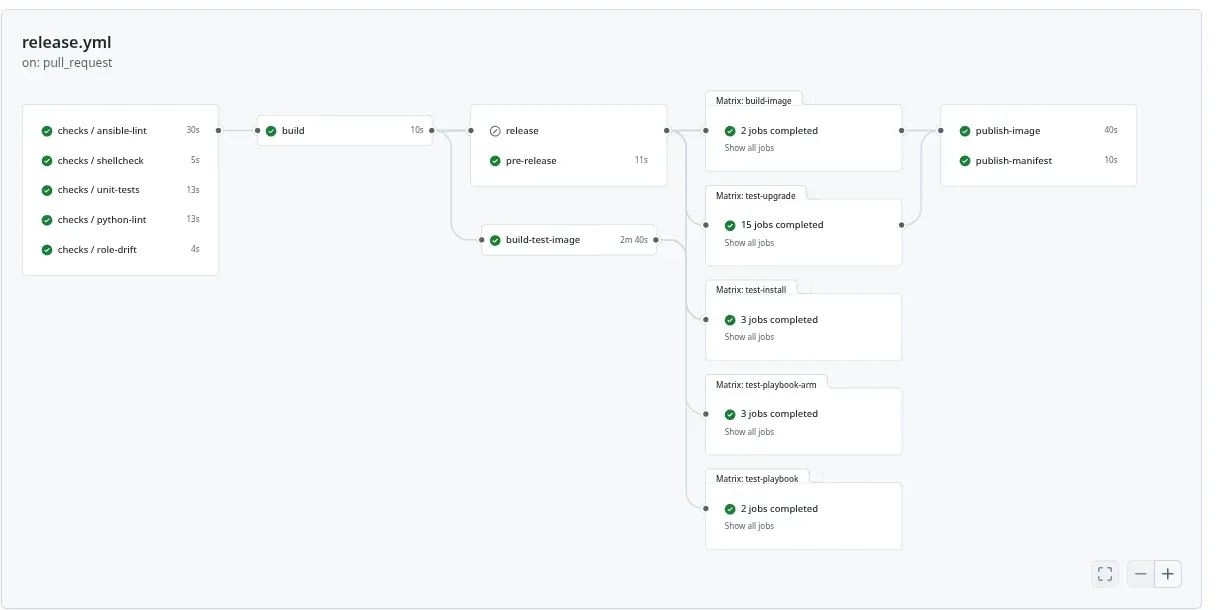
All of it lands on a single GitHub Release. The URLs users hit, odio.love/install, /manifest.json, and /odio.rpi-imager-manifest, are 307 redirects served by the odio.love Astro site on Vercel, pointing at github.com/b0bbywan/odios/releases/latest/download/<asset>. The URLs stay stable across releases, so curl -fsSL https://odio.love/install | bash never needs updating. Pinning a specific version means calling the GitHub URL with the tag directly, as shown in Upgrade.
PWA and Home Assistant
Section titled “PWA and Home Assistant”odio-pwa releases on v* tags. release.yml zips the built dist/ as odio-pwa-<version>.zip, then builds the Docker image for amd64 and arm64 on their own native runners, pushes each by digest, and merges the digests into one multi-arch tag on ghcr.io/b0bbywan/odio-pwa. Prereleases (tags containing -) are marked as such on GitHub; only stable releases move the :latest tag on the container registry.
odio-ha uses a two-step pattern: a semver-tagged push runs the CI workflow, and a separate workflow waits for CI to succeed via workflow_run before creating the release. Prerelease detection is based on the tag suffix (-alpha, -beta, -rc).
The three Python packages, mpd2mpris, snapclientmpris, and pyodio, also publish the sdist and wheel they build to PyPI through trusted publishing: the job authenticates with a short-lived OIDC token bound to the repository and workflow, so there is no API token to store or rotate. Every tag goes to TestPyPI; release candidates stop there, and only final releases go on to PyPI.
Secrets and trust
Section titled “Secrets and trust”The pipeline relies on three scoped secrets:
APT_REPO_TOKEN, a personal access token withreposcope onb0bbywan/odio-apt-repo. Held by component repos so they can fire cross-repo dispatches. Nothing else can trigger the apt-repo rebuild from outside.GPG_PRIVATE_KEY, held only byodio-apt-repo. Used byrepreproto sign theReleasefiles, soaptclients on every odio node can verify the signature chain before installing anything.RELEASE_PAT, held by the two repos that track an upstream project. Used for one thing only: pushing the tag that a new upstream release produces. A tag pushed with the default token starts no workflow, so without it the build the tag exists to trigger would never run.
PyPI publishing needs no secret at all: the three Python packages authenticate with a short-lived OIDC token that PyPI trusts because of which repository and workflow asked for it.
Everything else (creating GitHub Releases, downloading release assets in another repo, deploying to Pages) uses the default GITHUB_TOKEN scoped to each workflow run.
Manual verification on hardware
Section titled “Manual verification on hardware”On top of the automated matrix, two Raspberry Pis cover the manual checks, with split responsibilities:
- A Pi 3B+ (arm64), a dedicated test rig, validates each PR. The
pr-Npre-release is run both as an upgrade from the previous release to the PR version, and as a reflash from the PR’s image. - A Pi B+ (armv6) takes the post-publication upgrade path: every newly-tagged stable is applied to the previous one on this board, after the release ships. This is also the maintainer’s production node, where a full playbook run takes around two hours, so it picks up upgrades on a post-publication cadence rather than mid-cycle.
Transcripts of these sessions, Ansible PLAY RECAP outputs with failed=0, and the upgrade paths walked are kept publicly in the upgrade-system RFC. That discussion also captures many additional manual hardware runs done while the upgrade system was being built out, kept as design notes rather than a per-release routine.
Repository overview
Section titled “Repository overview”The ecosystem is nineteen repositories, most connected to each other at build time (Go modules, .deb ingest into the apt repo, archives fetch at install time) or at runtime (client apps hitting the API over HTTP). Green solid edges are build, install, or deploy events; grey dashed edges are runtime. The hosting row at the bottom shows which platform serves each public endpoint: GitHub Pages for apt.odio.love and stats.odio.love, Vercel for everything else. Deploy arrows point from each hosted artifact down to its platform, and the apt install arrow goes from GitHub Pages back up to odios, since that’s where the .deb actually lands at install time.
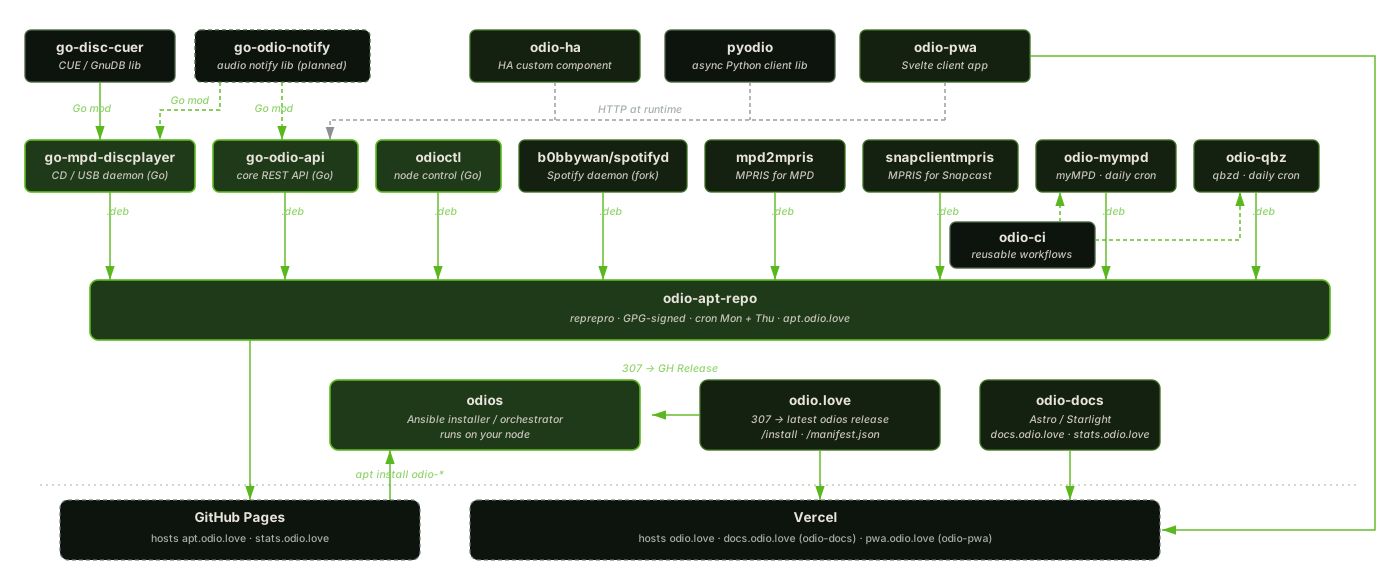
| Repo | CI | Release output | Role in the ecosystem |
|---|---|---|---|
| go-odio-api | Go tests, lint, coverage, CSS build | .deb + .rpm (4 arches), multi-arch GHCR image | Core REST API, installed on every node via apt install odio-api. Consumed at runtime by odio-pwa and odio-ha over HTTP |
| odioctl | gofmt, golangci-lint, go test -race, sudoers drift, .deb smoke test | .deb (3 arches) + bare binaries | Node control: upgrades, components, DAC overlay, and the settings page. Installed via apt install odioctl |
| go-mpd-discplayer | gofmt, golangci-lint, build matrix | .deb (4 arches) | CD / USB auto-play daemon, installed via apt install mpd-discplayer. Embeds go-disc-cuer as a Go module |
| go-disc-cuer | build, test, golangci-lint | Go library, tagged releases | CUE sheet + GnuDB / MusicBrainz lookup, compiled into go-mpd-discplayer |
| go-odio-notify | Go matrix, lint, coverage | Cross-arch binaries | Shared audio notification lib. Planned as Go module dependency for go-odio-api and go-mpd-discplayer |
| odios | ansible-lint, shellcheck, playbook + install + upgrade tests | Installer tarball, Pi images, Imager manifest | Orchestrator. Adds apt.odio.love as a source, installs odio-api, odioctl, mpd-discplayer, spotifyd, mpd2mpris, mympd, qbzd, snapclientmpris, and optionally odio-kiosk |
| odio-pwa | svelte-check, Vitest | Zip archive, multi-arch GHCR images | Standalone client app, talks to go-odio-api over HTTP at runtime |
| odio-ha | ruff, mypy, pytest, HACS + hassfest | GitHub Release, CI-gated | Home Assistant custom component, talks to go-odio-api over HTTP at runtime |
| pyodio | ruff, mypy, pytest (3.12 to 3.14) | sdist + wheel on PyPI, GitHub Release | Async Python client for odio-api: a live state mirror over SSE, a high-level hub and a low-level REST client |
| mpd2mpris | ruff, mypy, pytest, make check-tag on v* | .deb (arch:all), sdist + wheel on PyPI | MPRIS2 D-Bus bridge for MPD. Complete rewrite around python-mpd2 and dbus-fast, with as_directory-aware cover-art lookup for virtual CUE folders. Ingested into apt.odio.love |
| snapclientmpris | ruff, mypy, pytest, make check-tag on v* | .deb (arch:all), sdist + wheel on PyPI | MPRIS2 D-Bus bridge for the local Snapcast client. Forwards Play/Pause/Next/Previous to the snapserver source so multi-room pauses pause every listener. Ingested into apt.odio.love |
| odio-framebuffer-ui | builder images, per-arch native build, lintian, ELF gates | .deb (amd64, arm64) | odio-kiosk, a Qt 6 WebEngine browser drawn straight onto the framebuffer, one instance per screen. Shows the embedded UI on the local screen. Ingested into apt.odio.love |
| odio-mympd | builder images, per-arch build, ELF gates | .deb (3 arches) | Build-only pipeline (no source vendored). Daily cron tracks upstream jcorporation/myMPD; tagging here ships the matching myMPD .deb to apt.odio.love |
| odio-qbz | per-arch native build, ELF gates | .deb (3 arches) | Build-only pipeline for qbzd, the headless Qobuz daemon from upstream vicrodh/qbz, patched, with the armhf build upstream doesn’t ship |
| spotifyd | Rust build matrix | .deb (4 arches) | Fork of Spotifyd carrying the CI that ships .deb to apt.odio.love, no source changes. Provides Spotify Connect |
| odio-ci | (reusable workflows and actions) | Immutable vX.Y.Z releases | Shared CI plumbing: release + apt-repo dispatch, upstream watching, resolve-version and check-binary, and the pinned base images |
| odio-apt-repo | shellcheck, --help smoke test, PR build of the signed repo | apt.odio.love via GitHub Pages | Ingests .deb from go-odio-api, odioctl, go-mpd-discplayer, spotifyd, mpd2mpris, snapclientmpris, odio-mympd, odio-qbz, and odio-framebuffer-ui |
| odio.love | ESLint, astro check, Vitest, CSP + obfuscation checks, lychee, redirect check | Stable 307 redirects | Serves /install, /manifest.json, /odio.rpi-imager-manifest from the latest odios GitHub Release |
| odio-docs | Astro build, lychee, cspell | Deployed separately, plus a daily stats build | This site. A daily workflow also publishes the ecosystem stats behind the activity page to stats.odio.love |
Acknowledgments
Section titled “Acknowledgments”- The people whose work and thinking have inspired me through odio’s development.
- Laurent T., for the Pi 3B+ used for per-PR testing, which keeps that loop off my production node.
- @vascoguita, for raspios-docker, the per-arch Raspberry Pi OS Docker images that every ARM
.deband the upgrade test images are built on top of. Specifically:- go-mpd-discplayer’s Dockerfile cross-builds the CGO
.debfor arm64/armhf insidevascoguita/raspios:arm64andvascoguita/raspios:armhfunder QEMU. - spotifyd’s Dockerfile.builder uses the same bases for the
spotifyd-builderimage published to GHCR. - odio-mympd’s per-arch builders are rebuilt monthly on top of the same images.
- odios’s test image targets the same bases so the upgrade matrix runs against a Pi-faithful environment, and
scripts/img-to-docker.shderives the upgrade-test baselines following the same approach.
- go-mpd-discplayer’s Dockerfile cross-builds the CGO